Advertising has always been a game of attention and now, AI has completely rewritten the rules of how you win it. What used to take a full creative team, three rounds of revisions, and a week on the calendar can now be done in an afternoon. The tools available today don't just speed things up; they change what's possible, especially for lean teams and solo marketers playing at the level of bigger brands.
But not all AI ad tools are built the same. Some excel at visuals, others at copy, and a few genuinely do both well. After digging into the landscape, here are the seven best tools worth your time and money.
1. AdCreative.ai
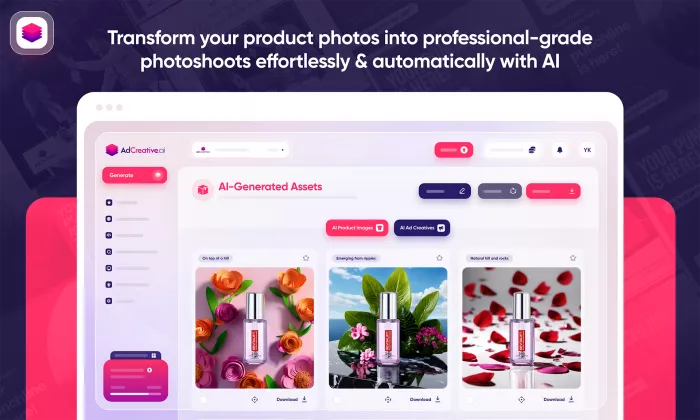
AdCreative.ai is purpose-built for one thing: generating conversion-focused ad creatives at scale. You feed it your brand assets, define your target audience, and it produces ready-to-use static ad creatives across formats social, display, and beyond ranked by a proprietary AI score that predicts which designs are most likely to convert.
What sets it apart is the data intelligence underneath. The platform has been trained on millions of high-performing ads, so the creative output isn't just pretty it's strategically informed. You also get competitor insights, which lets you see what kinds of ads are working in your niche before you even start designing.
The platform covers the full creative workflow: copy generation, image generation, video ads, and batch production. For teams running paid social or Google Display campaigns at any meaningful volume, the time savings alone justify the price.
Pros: Exceptionally fast output, strong conversion-prediction scoring, competitor ad intelligence, scales effortlessly for multi-brand agencies.
Cons: Creative output can feel templated after extended use; less suited for brand campaigns where pure originality matters.
Pricing: Starts at $29/month for the Starter plan. Professional and Ultimate tiers scale up to $149/month and $249/month respectively, with a 7-day free trial available.
Best for: Performance marketers, e-commerce brands, and agencies running high-volume paid campaigns.
2. Pencil
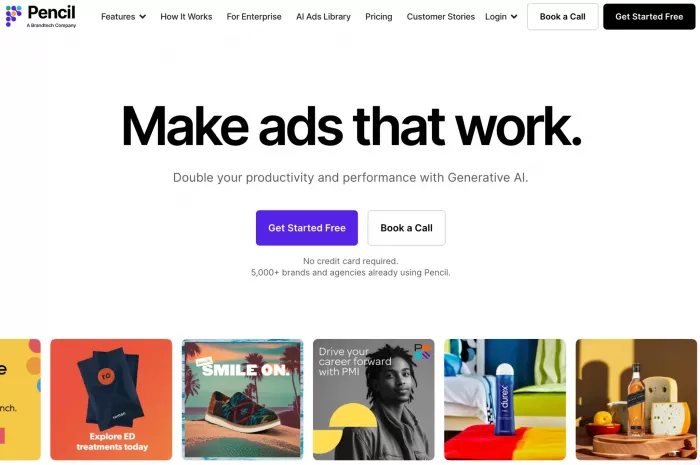
Pencil takes a performance-first philosophy and runs with it. It connects directly to your ad accounts Meta, TikTok, Google ingests your historical performance data, and uses that real information to inform what creative it generates next. The idea is that your best-performing ads are the training data for your future ones.
The platform handles video ads particularly well, assembling short-form content from your existing assets, AI-generated voiceovers, and copy variants. It's built for iteration: you can spin up dozens of concept variations quickly and let the live data decide which ones win.
What makes Pencil genuinely different from most tools is its AI Spend Score, a predictive metric that estimates which ad concepts will deliver results before you spend a cent on media. That feedback loop between creative and performance data is rare, and valuable.
Pros: Deep integration with ad platforms, strong video ad capabilities, predictive performance scoring tied to real spend data.
Cons: Learning curve is steeper than simpler tools; the value compounds with time, so early results can feel underwhelming.
Pricing: Starts around $119/month. Enterprise pricing available on request.
Best for: Growth marketers and DTC brands who want creative decisions driven by performance data rather than gut instinct.
3. Copy.ai
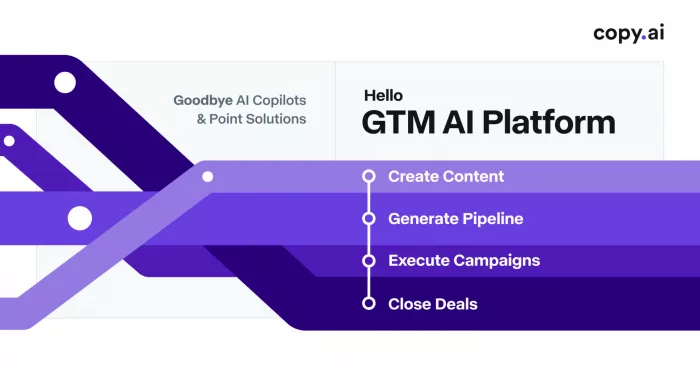
Copy.ai started as a general-purpose writing tool and has grown into one of the most powerful platforms for ad copy specifically. The interface is clean, the output quality is consistently high, and the workflow features including automated pipelines and brand voice training make it genuinely useful for teams, not just individuals.
For ad creation, Copy.ai shines in its breadth. You can generate Facebook ad copy, Google responsive search ads, product descriptions, landing page headlines, and email sequences all from one place. The Brand Voice feature is particularly well-executed: train it on your existing content and it will generate copy that actually sounds like you, not like a generic AI.
The platform has recently invested heavily in agentic workflows, meaning you can build automated pipelines that take a product URL and output a full set of ad variations without manual prompting at every step. For content-heavy operations, this is a meaningful upgrade.
Pros: High-quality copy output, excellent brand voice customization, versatile beyond just ads, strong workflow automation.
Cons: Lacks native image or video generation, so you'll need a separate tool for visuals.
Pricing: Free plan available (limited outputs). Pro plan starts at $49/month. Team plans from $249/month.
Best for: Copywriters, content marketers, and teams who prioritize sharp ad copy and need to produce it consistently at scale.
4. Canva Magic Studio (AI)
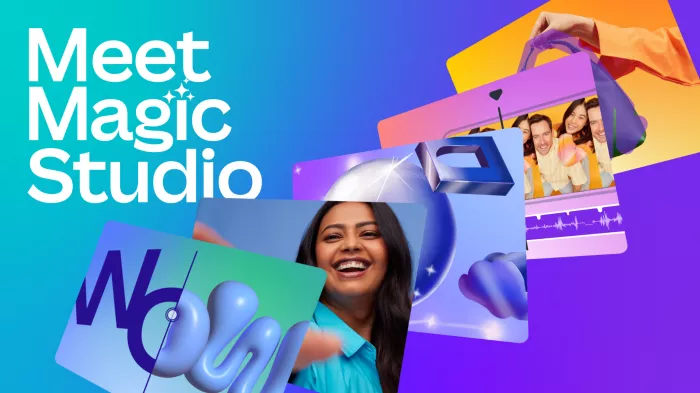
Canva is no longer just a design tool, it's become a serious AI-powered creative platform, and its Magic Studio suite makes that clear. For ad creation specifically, the combination of Magic Write (AI copy), Magic Media (text-to-image generation), Magic Resize, and a massive library of ad templates makes it the most complete all-in-one tool for teams without dedicated designers.
The real advantage Canva has over more specialized tools is familiarity and accessibility. Most marketing teams already use it, which means the AI features slot directly into existing workflows. You can design a Facebook ad, resize it for Instagram Stories and Google Display, write the caption, and export everything without leaving the platform.
Magic Media's image generation has improved significantly, and while it's not the most powerful image generator on the market, it's good enough for most commercial ad work and benefits enormously from being embedded in a fully functional design environment.
Pros: All-in-one creative environment, easy to use, excellent resizing and format adaptation, strong template library, accessible for non-designers.
Cons: AI image quality lags behind dedicated tools like Midjourney; power users may find it limiting compared to Photoshop or Figma.
Pricing: Free plan available. Canva Pro is $15/month per person. Canva Teams starts at $10/person/month (minimum 3 users).
Best for: Small business owners, social media managers, and marketing teams that need good-looking ads fast without a steep learning curve.
5. Midjourney (+ ChatGPT or Claude for Copy)
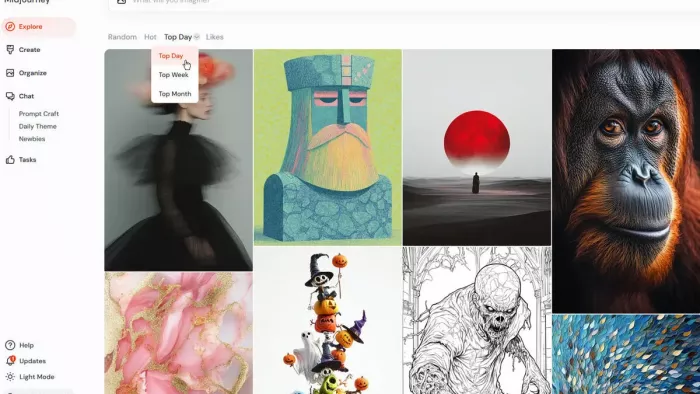
Midjourney deserves its own entry because when it comes to pure visual quality for ad imagery, nothing currently available comes close. The images it produces have an editorial depth and craft that clearly distinguish them from stock photography or other AI generators and for brands where visual identity is everything, that difference is felt immediately.
Used strategically, Midjourney becomes a powerful part of an ad creation stack. You brief it with detailed prompts to generate hero images, lifestyle photography, product scenarios, or abstract brand visuals, then bring those assets into Canva, Figma, or Adobe Express to build the final ad. Pair it with a strong language model for the copy layer and you have a genuinely professional production pipeline.
The limitation is that Midjourney isn't an end-to-end ad tool it doesn't do copy, it doesn't do resizing, and it requires prompt craftsmanship to get consistently good results. But for creative directors, brand agencies, and anyone for whom visual quality is non-negotiable, this is the best option available.
Pros: Unmatched image quality and creative range, excellent for building a distinct visual brand, highly flexible for different aesthetics.
Cons: No ad-specific workflow features, copy and layout must be handled elsewhere, prompt skill required for best results, Discord-based interface isn't for everyone.
Pricing: Basic plan starts at $10/month. Standard plan at $30/month. Pro plan at $60/month.
Best for: Brand-conscious marketers, creative agencies, and anyone who needs visually exceptional ad imagery and is comfortable assembling a multi-tool workflow.
6. Runway
Runway is where video ad creation gets serious. As short-form video continues to dominate paid social Reels, TikTok, YouTube Shorts the ability to produce compelling video content without a production crew has become a real competitive edge. Runway provides exactly that.
Its Gen-3 Alpha model generates high-quality video from text prompts or reference images, and the platform includes a full suite of video editing tools: motion brush, background removal, image-to-video, and inpainting. For brands running video ads, you can go from concept to final cut without leaving the platform.
Runway is also exceptional for repurposing existing footage. Feed it a product photo and it generates motion. Give it a raw clip and it extends, remixes, or stylizes it. For performance marketers who know that video drives better CPMs but have historically lacked the resources to produce it, Runway is one of the most valuable tools in this list.
Pros: Industry-leading video generation quality, comprehensive editing suite, excellent for both creating and repurposing video content.
Cons: Steeper price point, video generation can be slow, complex prompting needed for precise results.
Pricing: Free plan with limited credits. Standard plan at $15/month. Pro plan at $35/month. Unlimited plan at $95/month.
Best for: Social media managers, video-first brands, and performance marketers investing in video ad creative.
7. Smartly.io
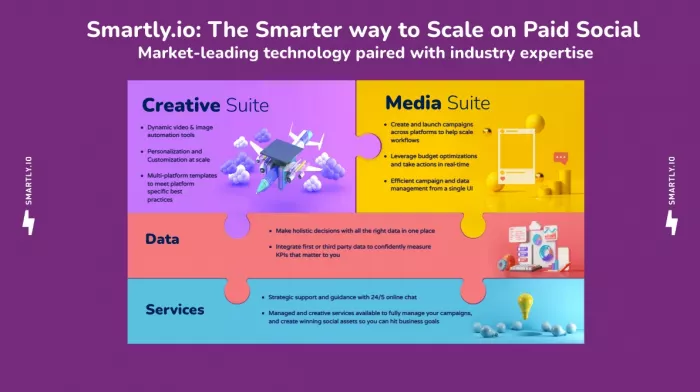
Smartly.io operates at a different scale than the other tools on this list; it's an enterprise-grade platform built for brands and agencies managing significant ad spend. Where other tools help you create ads, Smartly helps you create, test, personalize, optimize, and distribute them programmatically across Meta, TikTok, Snapchat, Pinterest, and Google simultaneously.
The creative automation features are genuinely impressive. You can build dynamic templates that pull in product data to generate thousands of personalized ad variations, each tailored to different audience segments or retargeting scenarios. Combined with its media buying automation, it closes the loop between creative production and campaign performance.
It's not a tool for small budgets or solo marketers the pricing and complexity reflect its enterprise positioning. But for agencies running large-scale campaigns where manual ad creation and trafficking would be impossible to sustain, Smartly is the most complete platform available.
Pros: Unmatched scale for creative production and distribution, powerful dynamic personalization, strong cross-platform campaign management.
Cons: Expensive, complex to set up, and well beyond the needs of most small-to-mid-sized teams.
Pricing: Custom pricing based on ad spend and usage. Generally starts in the thousands per month.
Best for: Enterprise marketing teams, large agencies, and brands running multi-million dollar ad programs across multiple platforms.
How to Choose the Right Tool
The honest answer is that most serious ad programs end up using two or three of these tools together rather than one. A typical high-performing stack might look like this: Midjourney for hero visuals, Copy.ai for copy variations, and AdCreative.ai to assemble and test at volume. Or for video-first brands: Runway for the creative, Pencil to connect it to performance data, and Smartly to distribute at scale.
What you shouldn't do is try to find a single tool that does everything perfectly that tool doesn't exist yet. What does exist is a collection of genuinely powerful, specialized tools that, combined thoughtfully, give you creative firepower that wasn't accessible to most teams even two years ago.
Start with your biggest bottleneck. If copy is slowing you down, start with Copy.ai. If you're burning time on design, start with Canva or AdCreative.ai. If the video is the gap, go straight to Runway. Build from there.
The brands winning with AI-powered advertising aren't the ones who found the perfect tool they're the ones who built the fastest, most iterative creative process. These tools make that possible.


Comments