How a single person, a laptop, and a stack of smart tools became a real company.
Not long ago, starting a business meant a plan, a bit of money, and usually a few other people to get anything off the ground. You needed someone who could build the thing, someone who could sell it, and someone to keep the books straight. If you could not afford all three, you went without and hoped for the best. Somewhere in the last few years, that math quietly flipped.
A single person with a laptop, a real idea, and a handful of tools can now run something that looks and behaves like an actual company. Most of the roles that used to require a hire can be rented by the month or handed to software that did not exist a short while ago. The office is a browser tab. The team is a subscription list. And the whole thing can be up and taking payments before lunch.
This is not a fringe story about a few lucky people on the internet. It has become one of the biggest shifts in how work actually happens, and the numbers back it up in a way that is genuinely hard to argue with. So let us walk through what a one-person internet business really is, why it is suddenly everywhere, and what it honestly takes to make one work.
What we actually mean by a one-person business
The phrase gets thrown around loosely, so it is worth pinning down. A one-person internet business is a real business, with its own brand and its own customers, that is run and largely operated by a single person and reaches those customers mostly online. It is not a hobby that occasionally makes money, and it is not the same thing as picking up gig shifts, although the lines do blur. The defining trait is ownership. You are not renting your time to a platform. You are building something that is yours.
It shows up in a lot of shapes. A freelance designer with a waiting list is one. So is a newsletter writer with a few thousand paying subscribers, a consultant billing three clients, a person selling templates or courses, someone running a tidy little software product, and a creator who has turned an audience into a storefront. Different surfaces, same underlying pattern: one person, a clear offer, and the internet doing the distribution.
This stopped being a niche a long time ago
If your mental picture of a business is an office with a payroll, the data will surprise you. In the United States there are roughly 36 million businesses, and about 30.4 million of them have no employees at all beyond the owner. That is around 84 percent of every business in the country operating as a team of one. These are not companies waiting to grow up. For most of them, one person is the permanent, intended structure.
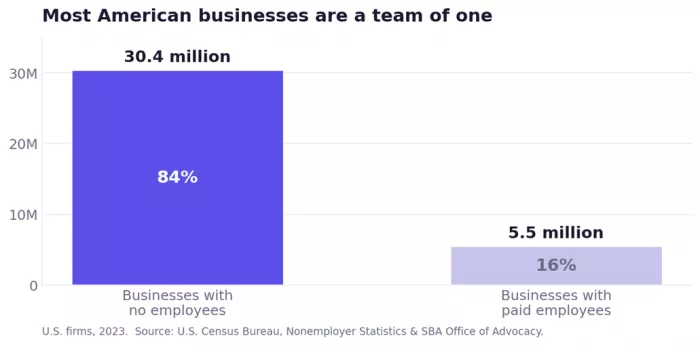
Figure 1. In the U.S., businesses without employees outnumber those with staff by more than five to one.
This is not a static picture either. From 2012 through 2023, the number of these solo businesses grew by about 2.7 percent a year on average, while businesses with employees grew only about 1.1 percent. The solo end has outpaced the traditional end nearly every single year. Together these tiny firms brought in around 1.7 trillion dollars, which is roughly 6.8 percent of the whole economy, and women own close to 43 percent of them. Whatever you want to call this, small is not the word for it.
The creator side of the story is climbing just as fast. The global creator economy was worth somewhere around 250 billion dollars in 2025, and credible forecasts have it passing a trillion dollars within the next several years. More than 200 million people worldwide now describe themselves as creators, and in the United States alone over 64 million people freelance in some form. The number of full-time independent workers roughly doubled between 2020 and 2024. This is a structural change in how people earn a living, not a passing trend.
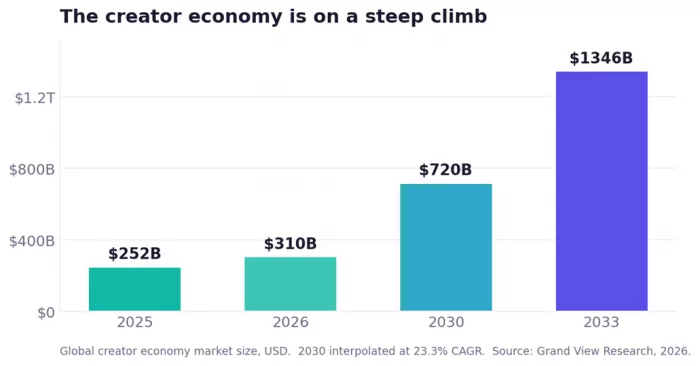
Figure 2. The creator economy is projected to roughly quintuple over the back half of the decade.
Why this is happening now
None of this would be possible if the tools had stayed where they were. Three things had to come together at once, and over the past couple of years they finally did.
First, the tools got good enough to replace whole roles rather than just speed up tasks. This is the AI part, and it is not hype. Among small businesses, regular use of AI jumped from under half in mid-2024 to more than three quarters by early 2026. For a solo operator, an AI assistant is the closest thing there is to a first hire. It drafts the copy, cleans the spreadsheet, answers the first round of support emails, and sketches the design, and it does not need onboarding or a salary.
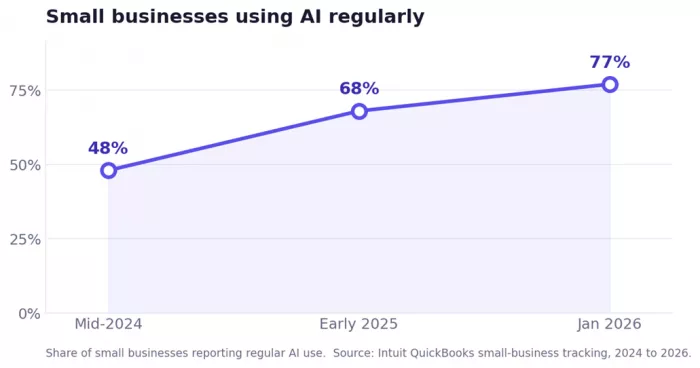
Figure 3. AI went from novelty to daily habit for most small businesses in under two years.
Second, almost everything became rentable by the month. There are no servers to buy, no office to lease, no five-figure software licenses to sign for. Hosting, payments, design, email, automation, and analytics are all a subscription now, and most of them have a free tier that carries you until you actually have customers. The upfront cost of looking professional has fallen close to zero.
Third, distribution got handed to individuals. You no longer need a marketing budget or a media company to reach people. You need something worth saying and a place people can find you. Search, social platforms, and word of mouth do the rest, and a single person can now build an audience that would have required a whole department a decade ago.
Put those together and the picture is clear. The jobs that used to justify a payroll have quietly turned into a stack of tools that one person can operate. Here is roughly how that swap looks.
| The role you used to hire | What covers it now |
|---|---|
| Developer or engineer | AI coding assistants and no-code app builders |
| Designer | Template-driven design tools with AI layout help |
| Copywriter or marketer | AI writing tools and scheduling apps |
| Bookkeeper | Automated accounting and invoicing software |
| Customer support | Chatbots and shared inbox tools with canned replies |
| Operations or admin | Workflow automation that runs tasks on triggers |
| IT department | Managed cloud hosting with nothing to maintain |
Table 1. The modern solo stack. Each subscription quietly stands in for a hire.
The shapes a one-person business takes
There is no single template, which is part of the appeal. The same tools and the same economics support a wide range of models, and plenty of solo operators run two or three of these at once. A few of the most common shapes:
| Type | What they sell | How the money comes in |
|---|---|---|
| The creator | Content, attention, and trust | Sponsorships, ads, memberships |
| The consultant | Expertise and time | Project fees and retainers |
| The product seller | Templates, courses, digital goods | One-off and repeat sales |
| The micro-SaaS | A small, focused software tool | Monthly subscriptions |
| The media brand | A newsletter or niche publication | Paid subscriptions and ads |
| The online store | Physical or print-on-demand goods | Product sales and margins |
| The agency of one | A done-for-you service | Packaged service fees |
Table 2. Seven common forms of the one-person internet business.
The economics quietly flipped
The most important change is not any single tool. It is what all of them together did to the risk of trying. Starting a business used to mean putting real money and often your job on the line before you knew whether anyone wanted the thing. Now you can test an idea for the price of a few subscriptions and an unglamorous stretch of evenings. If it does not work, you are out a bit of time and a small bill, not your savings.
| The old way | The one-person way | |
|---|---|---|
| Startup cost | Tens of thousands or more | Often under a hundred a month |
| Time to launch | Months of setup | Days, sometimes hours |
| Team needed | Several hires up front | Just you, plus tools |
| Downside risk | Your capital and your job | A few subscriptions and some time |
| Break-even | A distant, nervous goal | A handful of customers |
Table 3. The barrier to trying has fallen further than most people realise.
When the cost of an experiment drops that far, more people run experiments, which is exactly what the growth numbers are showing. It also changes the psychology of the whole thing. You are no longer betting the farm. You are placing a small, sensible wager and letting the market tell you whether to place a bigger one.
The part nobody warns you about
Here is the twist that catches a lot of solo founders off guard. Once building the thing gets easy, building the thing stops being the hard part. The new bottleneck is whether anyone can find you and whether they trust you enough to hand over money. When you are the whole company, you are also the brand, and the brand is you.
This is where things usually get messy. Your work ends up scattered across five platforms. Your latest project is on one site, your portfolio on another, your booking link somewhere in a bio, your contact details buried in an old post. Then a potential client hears your name, types it into a search bar, and finds either a confusing trail or nothing that quite lines up. In a world where a single person is competing on credibility, that scattered presence is a real cost.
Why presence became the whole game • About 68 percent of creators now consider themselves small business owners, so a personal profile is a business asset, not a vanity page. • When you are the company, a stranger's first impression of you is usually a search result, not a sales call. • Trust is built before the first conversation, on whatever people find when they look you up. |
The fix is not complicated, but it is easy to neglect. You need one clean home base that you actually control. A single place that says who you are, what you do, how someone can work with you, and where everything else lives, with a link you can put everywhere. That is the quiet difference between looking like a scattered side project and looking like a business. A profile platform like Zivolio exists for exactly this reason: to give a person or a business one tidy, professional profile that pulls everything into a single link and shows visitors, at a glance, that there is a real operation behind the name.
So, is it actually for you?
It would be dishonest to make this sound effortless. Running a business of one means you wear every hat, and the tools lighten the load without removing it. The income can swing from feast to famine, especially early on. There is no team to cover for you when you are sick or stuck, and you are the ceiling on everything, which is freeing and exhausting in roughly equal measure. Anyone who tells you it is passive is selling something.
What has genuinely changed is the cost of finding out whether it is for you. That used to be enormous. Now it is small. So the sensible move is the same one experienced builders keep coming back to: start with the smallest real version, keep your costs close to nothing, get one thing working before you add the next, and let an actual bottleneck, rather than a shopping list, tell you when to grow. You do not need the full stack on day one. You need a clear offer, a way to get paid, and a place people can find you.
Where this goes from here
The one-person internet business is no longer a scrappy substitute for a real company. For a growing share of people, it is the real company, and the tools underneath it are only getting sharper. The next wave, software that does not just assist but takes whole tasks off your plate and runs them, is already arriving, which pushes the ceiling on what a single person can manage even higher.
The people who do well with all of this will not be the ones who chase every new tool. They will be the ones who treat their solo venture like the business it is: a clear offer, a consistent presence, and a home base that people can find and trust. The barrier to starting has never been lower. The work of standing out, and of being findable when someone finally goes looking for you, is where the game is now played.


Comments