First, let’s be honest about what a personal brand is
Say “personal brand” out loud and half the room pictures a guy in a rented Lamborghini yelling about passive income. Understandable. But that’s marketing, not branding and it’s not what we’re doing here.
Your personal brand is simply the answer to one quiet question people ask when your name comes up: “Oh, that person, what are they about?” It’s the gut feeling someone gets before they’ve even spoken to you. You already have one, whether you built it on purpose or not. The only real choice is whether you get a say in what it says.
Here’s the good news for 2026: you don’t need to be famous, loud, or a natural on camera. You need to be clear, consistent, and genuinely useful to a specific group of people. That’s it. This guide walks you through exactly how, step by step, with templates and examples you can copy today.
▶ The one-line definition to keep in your head A personal brand is what people reliably expect from you, the topic they associate with your name, plus the way you make them feel while you deliver it. |
Branding vs. marketing vs. reputation — quick myth-check
People blur these three together and then get frustrated. Let’s untangle them so you know what you’re actually building.
| The myth | The reality |
|---|---|
| “It’s about going viral.” | It’s about being remembered by the right 1,000 people, not seen once by a million strangers. |
| “I need to post every single day.” | You need to post consistently. Three good posts a week beats seven rushed ones, every time. |
| “I have to show my face / be an extrovert.” | Faceless and quiet brands work fine. Clarity and usefulness matter far more than charisma. |
| “It’s bragging.” | Done right, it’s the opposite: you’re giving away help so freely that people trust you before you ever pitch them. |
| “Once I ‘make it,’ I can stop.” | A brand is a garden, not a monument. Small, regular watering, not one heroic push. |
Why 2026 is a strange and genuinely good time to start
The internet is more crowded than ever, and AI can now spit out a decent-looking blog post in nine seconds. So why bother? Because that flood is exactly the opportunity. When everyone can generate polished content, the thing that becomes scarce and valuable is a real human with a real point of view and a track record you can trust.
Three shifts worth knowing about
The trust gap is widening. As feeds fill with AI content, people crave a recognizable person to follow. “Who said this?” now matters as much as “what does it say?”
Audiences beat algorithms. Platforms change the rules constantly. An audience that knows you — especially an email list — is the one asset no algorithm update can take away.
Small and specific wins. You don’t need a huge following to change your life. A few thousand people who trust you can fund a business, a career pivot, or a book.
Which brings us to the single most important expectation to set before you start: this is slow at first, and then it isn’t. Almost everyone who quits does so in the first three months — right before the compounding kicks in.
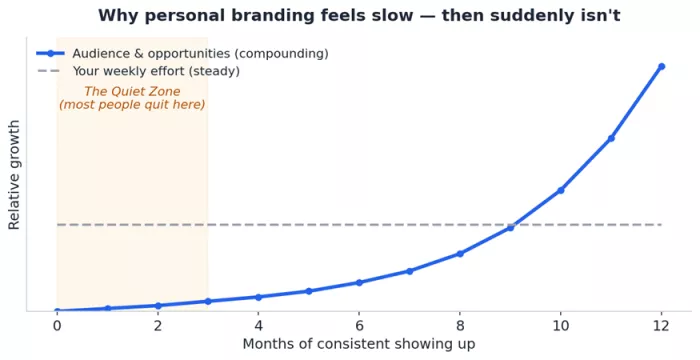
Your effort stays roughly flat. The results don’t, they compound. The trap is the “quiet zone” early on.
⚠ Set this expectation now and save yourself the heartbreak For the first 8–12 weeks it will feel like shouting into an empty room. That’s normal and it happens to everyone. You are not failing; you are building the base of the curve. Judge yourself on reps completed, not likes received. |
The 8-step framework at a glance
Here’s the whole journey on one page. We’ll take each step in detail after this, but skim the table first so you can see where we’re headed. Think of it as a ladder, each rung stands on the one below it, so resist the urge to jump straight to “posting.”
| # | Step | The question it answers | Time to set up |
|---|---|---|---|
| 1 | Position yourself | “Who am I for, and what for?” | 2–4 hours |
| 2 | Audit where you stand | “What do people find when they search me?” | 1 hour |
| 3 | Pick your platforms | “Where does my audience actually hang out?” | 1 hour |
| 4 | Optimize your profile | “Does my page sell me in 5 seconds?” | 2 hours |
| 5 | Choose content pillars | “What will I be known for talking about?” | 2 hours |
| 6 | Build a content system | “How do I keep this up without burning out?” | Ongoing |
| 7 | Grow through engagement | “How do I get discovered by the right people?” | Ongoing |
| 8 | Build an owned audience | “How do I turn attention into opportunity & income?” | Ongoing |
Step 1 · Position yourself (the step everyone skips)
If you get this step right, everything after it gets easier. Get it wrong, and you’ll post for a year and wonder why nothing sticks.
Positioning is just deciding, on purpose, who you help and what you help them with. The classic mistake is trying to be for everyone, which makes you memorable to no one. “I post about business, fitness, crypto, and my dog” is not a brand; it’s a group chat.
Find your sweet spot
Your best positioning lives where three circles overlap. Sit with a notebook and actually write out each one:
What you know / can do well — skills, experience, hard-won lessons, even “boring” expertise from your day job.
What you genuinely enjoy — because you’ll be talking about this for years. Boredom kills more brands than failure does.
What people actually want / pay for — problems others are already Googling, asking about, or spending money to solve.
The magic is in the overlap. A tax accountant who loves explaining money to freelancers, in plain language, has a far sharper brand than “finance guy.”
Turn it into a one-sentence positioning statement
Fill in this template. Rewrite it ten times until it sounds like a human, not a LinkedIn robot:
| “I help [specific person] do [specific outcome] through [your method / angle].” |
Here are three worked examples so you can feel the difference between vague and sharp:
| Vague (weak) | Sharp (strong) |
|---|---|
| “I’m a marketing consultant.” | “I help early-stage SaaS founders get their first 1,000 users without paid ads.” |
| “I post about health and wellness.” | “I help busy parents cook 20-minute high-protein dinners their kids will actually eat.” |
| “I’m a designer.” | “I help solo course creators turn ugly slides into premium-looking brands in a weekend.” |
Step 2 · Audit where you stand right now
Before you build anything new, find out what the internet already says about you. Open an incognito window and search your own name. Then run through this quick honesty checklist. Don’t judge — just note what needs fixing.
| Check | What “good” looks like | Your status |
|---|---|---|
| Google your name | You (not a stranger with your name) show up, with recent, on-brand results. | ☐ |
| Profile photos | Same clear, friendly headshot across every platform. | ☐ |
| Bios & handles | Consistent name/handle; each bio says who you help. | ☐ |
| Old content | Nothing embarrassing on the first page of results. | ☐ |
| A ‘home’ link | One place (site or link-in-bio) that ties it all together. | ☐ |
| Contactability | It’s obvious how someone would reach or hire you. | ☐ |
Step 3 · Pick your platforms (fewer than you think)
You do not need to be everywhere. Being everywhere is how people end up posting nowhere. Pick one “home base” you’ll master, and at most one secondary channel.
The right platform is wherever two things are true at once: your audience already hangs out there, and the format plays to your strengths. If you hate being on camera, don’t start with YouTube out of guilt. If you write well, that’s a superpower on LinkedIn, X, or a newsletter.
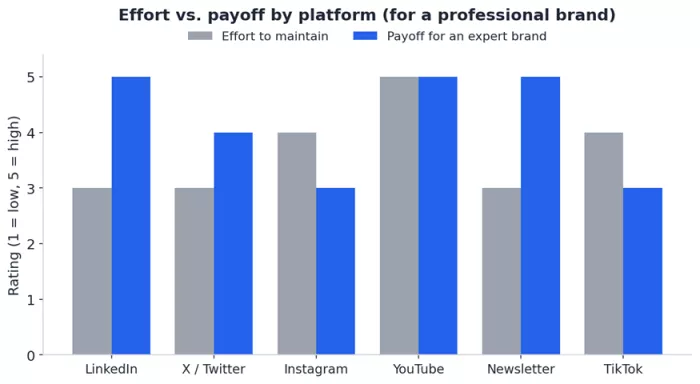
For most expert / professional brands, writing-first platforms give the best return per hour. Adjust for your niche.
A platform cheat sheet
| Platform | Best for | Format | Start here if… |
|---|---|---|---|
| B2B, careers, consultants, founders | Text posts, short docs | You want clients or a network of professionals. | |
| X / Twitter | Tech, writers, builders, ideas | Short posts, threads | You think in quick takes and love conversation. |
| Visual niches, lifestyle, local, coaching | Reels, carousels | Your work is visual or you enjoy short video. | |
| YouTube | Deep teaching, reviews, tutorials | Long & short video | You’re happy on camera and play the long game. |
| TikTok | Reach, younger audiences, trends | Short video | You want fast discovery and can be casual. |
| Newsletter | Owning your audience, depth, trust | You want a lasting asset you fully control. |
Step 4 · Optimize your profile so it works while you sleep
Every post you write sends curious people to one place: your profile. If that page is confusing, they leave. A good profile does three jobs in about five seconds, it tells people who you help, proves you’re legit, and makes the next step obvious.
The anatomy of a profile that converts
| Element | Get it right by |
|---|---|
| Photo | A clear, well-lit headshot. Friendly face, simple background. Same one everywhere so you’re instantly recognisable. |
| Banner / cover | Treat it like a billboard: your positioning line + who you help. Don’t leave the default. |
| Headline / bio | Lead with the outcome you create, not just your job title. “I help X do Y” beats “Senior Manager.” |
| Proof | One or two credibility hits: results, notable clients, numbers, or a signature piece of work. |
| Call to action | Tell them exactly what to do next: “Follow for weekly tips,” “Grab my free guide,” “DM me ‘audit.’” |
| The link | One tidy link-in-bio or website that gathers everything in one place. |
Before & after (steal this)
| Before (forgettable) | After (magnetic) |
|---|---|
| Bio: “UX/UI Designer | Coffee lover | Views my own” | Bio: “I fix the checkout screens costing D2C brands sales. 40+ stores redesigned. Free teardown ↓” |
Step 5 · Choose your content pillars
Content pillars are the 3–5 themes you’ll circle back to again and again. They stop the dreaded “What do I post today?” panic, and they train your audience to know exactly what you’re about.
Pick three to five topics that all ladder up to your positioning. Then, whenever you’re stuck, you just ask: “What can I say about one of my pillars today?” Here’s how Priya might set hers up:
| Pillar | What it covers | Example post idea |
|---|---|---|
| Teach | Practical UX and checkout tips | “5 checkout mistakes that quietly kill your sales” |
| Show | Behind-the-scenes of real projects | A before/after of a redesign (numbers included) |
| Opinion | Hot takes on design & e-commerce | “Why your ‘beautiful’ site might be losing money” |
| Story | Her journey, wins, and lessons | “The freelance mistake that cost me a client” |
| Proof | Results, testimonials, case studies | “How one button change lifted conversions 18%” |
The 70 / 20 / 10 mix so you never feel ‘salesy’
The fastest way to bore (or annoy) an audience is to only teach, or only sell. Balance it. A simple rule that works almost everywhere:
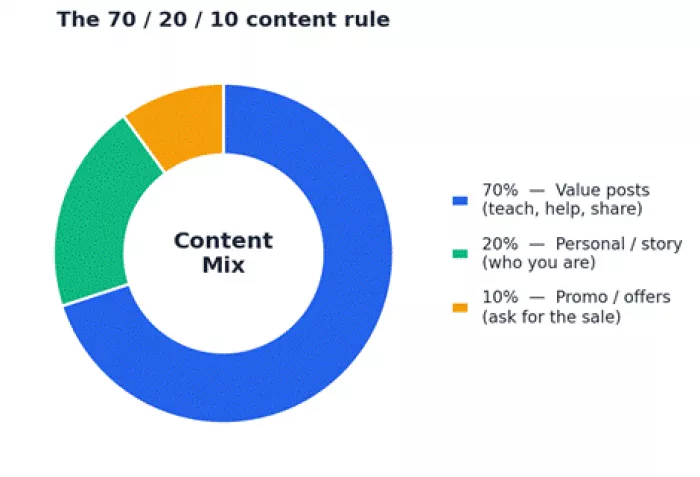
70% value — teach, help, entertain, share what you know. This is what earns trust and follows.
20% personal / story — who you are, your journey, opinions. This is what makes people care about you, not just your tips.
10% promo — actually ask for the sale, the booking, the sign-up. You’ve earned it with the other 90%.
⚠ The mistake almost everyone makes They do 100% value for a year, build a nice audience, and never once ask for anything — then wonder why the brand doesn’t pay off. Giving value is the price of entry. Making clear, confident offers is how the value comes back to you. Don’t skip the 10%. |
Step 6 · Build a content system you’ll actually stick to
Motivation is unreliable. Systems aren’t. The creators who last aren’t more disciplined than you — they’ve just removed the daily decision-making. Here’s the system in four moves.
1. Batch, don’t scramble
Set aside one focused block a week say 90 minutes on a Sunday and create several posts at once. Writing five posts in one sitting is far easier than writing one post five times, because you’re already “in the zone” and not fighting the blank page daily.
2. Keep a running idea list
Never sit down to a blank page. Keep a note on your phone and dump every question a client asks, every article that annoys you, every lesson you learn. That note is your content bank. A good post is often just a good answer to a real question someone asked you.
3. Repurpose ruthlessly (one idea, many posts)
You do not need endless new ideas, you need to squeeze each good one. One solid insight can become a week of content across formats:
| Start with | Turn it into |
|---|---|
| One newsletter / long post | A LinkedIn text post, an X thread, an Instagram carousel, and a short video script. |
| A client question | A quick tip post, plus a ‘myth vs fact’ graphic. |
| A finished project | A before/after case study, a lessons-learned story, and a testimonial post. |
| A popular past post | Rewrite it in 3 months with fresh examples — your new followers never saw it. |
4. Use a dead-simple calendar
Forget fancy tools at first. A basic weekly grid is plenty. Here’s a realistic starter cadence for a home base plus one secondary channel note how light it is. Sustainable beats heroic.
| Day | Home base (e.g. LinkedIn) | Secondary (e.g. Instagram) |
|---|---|---|
| Monday | Value post (a teaching tip) | — |
| Tuesday | Engage: comment on 5–10 posts | — |
| Wednesday | Story or opinion post | Repurpose Monday’s tip as a carousel |
| Thursday | Engage + reply to every comment | — |
| Friday | Proof / case study, or soft offer | — |
| Weekend | Batch next week’s posts (90 min) | Rest — seriously |
Step 7 · Grow by engaging, not just broadcasting
Here’s the secret nobody tells beginners: in your first months, the comments you leave on other people’s posts will grow you faster than your own posts do.
Posting is talking. Engaging is listening and joining the conversation and that’s where relationships (and reach) actually come from. When you leave a thoughtful comment on a bigger account’s post, their whole audience sees you being smart and generous. It’s the fastest, cheapest discovery there is.
The daily 15-minute engagement habit
- Make a short list of 15–20 accounts your ideal audience already follows, peers and slightly-bigger players in your niche.
- Each day, spend 15 minutes leaving genuine, additive comments, add a point, share an experience, ask a sharp question. Never just “Great post! 🔥”
- Reply to every single comment on your own posts. Every reply tells the algorithm your post is worth showing to more people, and tells the human you’re approachable.
- When someone interesting engages with you, start a real conversation in DMs. Not a pitch, a connection. Business follows relationships.
▶ Quality over quantity, always Ten thoughtful comments beat a hundred lazy ones. One human conversation beats a thousand impressions. You’re not farming a metric — you’re making the internet feel like a person is home. That’s the whole game. |
Step 8 · Turn attention into an audience you own (and income)
Followers are borrowed — the platform can change the rules or vanish overnight. So the moment people start paying attention, start moving them somewhere you control. That almost always means an email list, plus a clear path to work with you.
Build the one asset no algorithm can touch
Offer a simple ‘lead magnet’ — a free checklist, template, mini-guide, or teardown that solves one specific problem in exchange for an email.
Mention it naturally — in your bio, at the end of good posts, and in your link-in-bio. Not shouted, just consistently there.
Email your list regularly — even once a fortnight. Keep giving value so that when you do make an offer, people are glad to hear it.
The monetization ladder
You don’t jump straight from “first post” to “paid product.” You climb. Each rung deepens trust and raises what people will happily pay. Start where you are:
| Stage | What you’re building | How it pays off |
|---|---|---|
| Attention | Followers, reach, recognition | People know your name & topic |
| Trust | Email list, real conversations | People believe you can help them |
| Services | Freelancing, consulting, coaching | Trade time for good money; fast to start |
| Products | Courses, templates, ebooks, memberships | Earn while you sleep; scales beyond your hours |
| Leverage | Sponsors, partnerships, speaking, a book | Opportunities come to you |
The 7 mistakes that quietly kill personal brands
You’ll avoid most pain just by knowing these in advance. Be honest about which one is most likely to trip you up.
| Mistake | Why it hurts | Do this instead |
|---|---|---|
| Trying to appeal to everyone | You blur into background noise. | Niche down. Be unmissable to a few. |
| Waiting to feel ‘ready’ | ‘Ready’ never arrives; momentum dies. | Start messy this week. Improve in public. |
| Copying someone else’s voice | People smell a costume. | Sound like you texting a smart friend. |
| Chasing follower counts | Vanity numbers don’t pay bills. | Track conversations, emails, and clients. |
| Only teaching, never asking | You build goodwill but no income. | Make clear offers (that’s the 10%). |
| Quitting in the quiet zone | You bail right before it compounds. | Commit to 90 days, judge on reps. |
| Spreading across 6 platforms | You’re mediocre everywhere. | Master one. Add a second only when ready. |
Your 90-day action plan
Reading is nice. Doing is everything. Here’s a month-by-month plan so you always know the single most important thing to focus on. Don’t rush ahead — each month sets up the next.
Month 1 — Foundations (get set up, start posting)
● Week 1: Nail your positioning statement and pick your platforms (Steps 1–3).
● Week 2: Optimize every profile and set up a simple link-in-bio (Step 4).
● Week 3: Lock in your 3–5 content pillars and brainstorm 20 post ideas (Step 5).
● Week 4: Publish your first 3–5 posts. They’ll feel awkward. Post anyway.
Month 2 — Consistency (build the habit, start engaging)
● Post 3× a week using your pillars and the 70/20/10 mix.
● Start the daily 15-minute engagement habit (Step 7). This is where growth begins.
● Batch your content weekly so you’re never scrambling (Step 6).
● Create one simple lead magnet and start collecting emails (Step 8).
Month 3 — Momentum (double down, make your first offer)
● Review your analytics: which posts landed? Do more of those (Step 6).
● Deepen relationships — move good conversations into DMs and calls.
● Make your first soft offer (a service, a call, a product). Use that 10%.
● Keep going. You’re now at the point where most people quit — and where it starts working.
Where your time should go in these 90 days
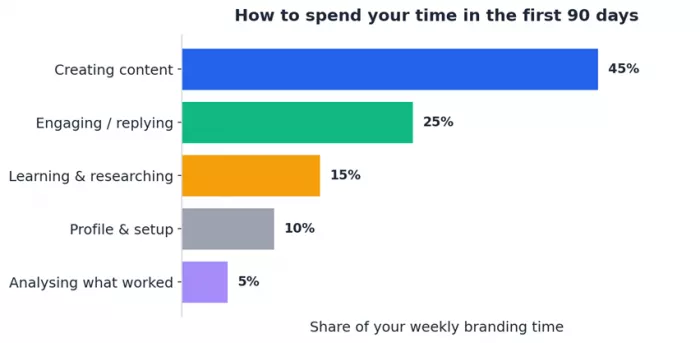
Notice how little time goes to ‘setup’ and ‘analysing.’ Most of it is creating and engaging. Don’t over-optimise, over-plan, or hide in dashboards.
A lean toolkit (don’t overspend early)
You can start with almost nothing. Add tools only when a real bottleneck appears, not because a YouTuber told you to. Here’s a sensible starting stack by job.
| Job to be done | Free / cheap options | Nice-to-have later |
|---|---|---|
| Writing & ideas | Notes app, Google Docs | An AI assistant to draft & refine |
| Graphics & carousels | Canva (free) | Canva Pro, Figma |
| Scheduling posts | Post manually at first | Buffer, Hypefury, Publer |
| Email list | MailerLite / Beehiiv (free tiers) | ConvertKit / Kit as you grow |
| Link in bio | Free link-in-bio tools | A simple one-page personal site |
| Basic analytics | Native platform stats | A light dashboard once you have data |
Measure what matters
It’s easy to obsess over likes and follower counts. But those don’t pay rent or build a career. Track the numbers that actually signal a healthy brand and give each one time to move.
| Vanity metric (feels good) | Real metric (does good) |
|---|---|
| Total followers | New email subscribers |
| Likes per post | Meaningful comments & DMs started |
| Impressions | Profile visits & link clicks |
| Going viral once | Consistent saves/shares (people found it useful) |
| Follower count milestones | Inbound opportunities: clients, offers, invites |
The only two things you really need to remember
If you forget this entire guide, keep these:
1. Be clear. Know exactly who you help and what for. Clarity is a superpower in a noisy world.
2. Be consistent. Show up usefully, week after week, long enough for the compounding to kick in.
Everything else, the platforms, the tools, the tactics is just detail hanging off those two ideas. You don’t need permission, a big audience, or perfect confidence. You need a clear message and the patience to repeat it.
✔ Your move, today Don’t close this file and “start Monday.” Do one tiny thing right now: write your positioning sentence, fix one bio, or leave three genuine comments on posts in your niche. The best time to start was years ago. The second-best time is the next ten minutes. |



Comments