Your Bio Link Is the Hardest-Working Pixel You Own
On every platform you post to, you get one clickable line. That single link in your bio is the bridge between attention and everything you are actually trying to build: your email list, your shop, your latest video, your bookings. It is, as Sprout Social puts it, “the hardest-working piece of real estate on your profile.” And yet most creators set it up once, celebrate, and never look at it again.
That neglect is expensive. Campaigns end but their links stay live. A tool changes its URL structure and your button quietly 404s. A landing page that loaded fine last quarter now crawls on mobile. None of this announces itself, your follower count keeps rising while your conversions silently leak away. The fix is not a redesign. It is a habit: a fast, repeatable monthly audit that catches problems before they cost you a month of clicks.
The one-line promise of this guide In about 30 seconds a month you can catch the handful of issues that quietly kill bio-link conversions. This playbook gives you the exact 8-point checklist, how to run each check, the numbers to watch, and a printable routine you can repeat forever. |
Why it matters more in 2026 than ever
Bio links are no longer a vanity list, they are a measurable funnel. Organic bio-link traffic typically converts at 1–3%, which already outperforms the average paid-social click-through rate of roughly 1.2% (WordStream, 2025). Get the funnel right and a well-optimised page can rival email, the highest-performing owned channel at about 2% CTR. Get it wrong or let it rot and you are pouring reach into a bucket with a hole in it.
The chart below shows why where the click starts matters as much as the link itself. The same destination converts very differently depending on the path a follower takes to reach it.
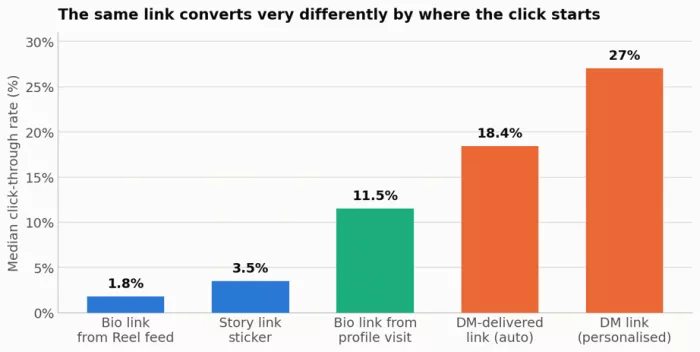
Figure 1 — Median click-through rate by traffic source. Warmer, more intentional paths (profile visits, DMs) convert far better than a cold tap from the feed. Sources: Creator Lane, ManyChat, Inro (2026).
What a Bio Link Audit Actually Is (and Why 30 Seconds)
A bio link audit is a short, structured review of the single link in your social profiles and the page it points to. You are not rebuilding anything. You are running down a fixed checklist to confirm that every link works, the page loads fast on a phone, the branding is consistent, there is one obvious action to take, and your tracking is capturing the clicks. Then you fix the single weakest thing you found and note your key number.
It takes 30 seconds because it is deliberately shallow and repeatable. A deep optimisation project, redesigning the page, running A/B tests, rewriting copy is quarterly work. The monthly audit is the smoke alarm: a fast pass whose only job is to catch the obvious failures that would otherwise go unnoticed for weeks. The whole loop breaks into three short phases.
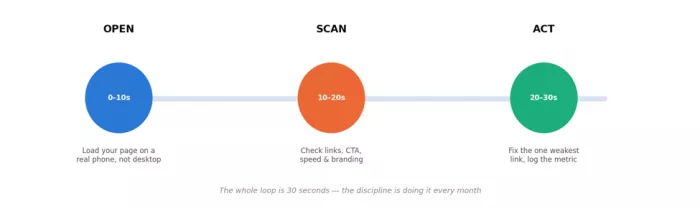
Figure 2 — The 30-second loop: Open on a phone, Scan the essentials, Act on the weakest point. Repeat monthly.
Audit vs. optimisation — don’t confuse them The monthly audit answers “is anything broken or stale?” in 30 seconds. The quarterly optimisation answers “how do I make it convert better?” over an hour or two. This guide is about the first but section 7 shows how the audit feeds the second. |
The Anatomy of a High-Converting Bio Link Page
Before you can audit a page, you need to know what “good” looks like. Whether you use a native link field, a link-in-bio tool, or a custom landing page, the highest-converting setups share the same handful of parts. Keep this mental model in front of you while you run each check.
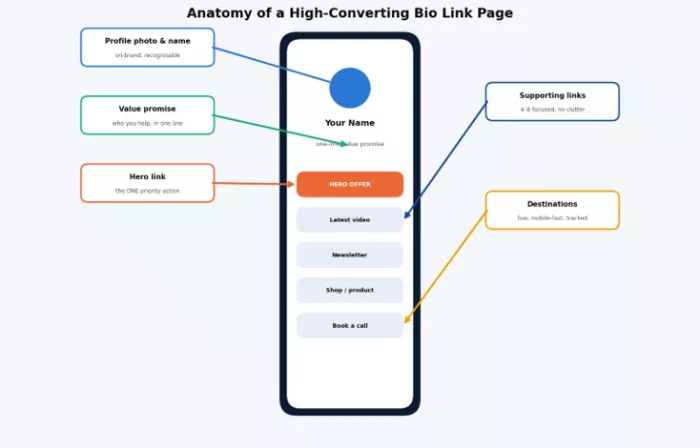
Figure 3 — The building blocks of a bio link page that converts.
| Element | What great looks like |
|---|---|
| Profile photo & name | Recognisable, on-brand, consistent across every platform. The name field is searchable, use a keyword, not just your handle. |
| Value promise | One line, under ~150 characters, that says who you help and how. This is your elevator pitch, not a list of hobbies. |
| Hero link | The single most important action right now, visible without scrolling. If everything is highlighted, nothing is. |
| Supporting links | 4–8 focused options, ordered by priority. More than that causes analysis paralysis and depresses clicks. |
| Destinations | Every link resolves to a live, mobile-fast, on-brand page wrapped in a branded short link and tagged for tracking. |
| Clear CTA copy | Action-first button text (“Get the free guide” beats “Guide”). Small wording changes compound over a high-traffic page. |
Before You Start: Set a Baseline
An audit is only useful if you can tell whether things are getting better or worse. Spend two minutes on your very first audit setting up the basics; after that, the monthly pass really does take 30 seconds.
Pick one number to track. For most creators that is bio-link click-through rate (clicks ÷ profile visits). Record it each month so you have a trend, not a guess.
Turn on analytics. Use your link-in-bio tool’s built-in stats, or add UTM parameters so clicks show up in Google Analytics. You cannot improve what you do not measure.
Use branded short links. A link that reads yourbrand.com/offer builds trust and lets you change the destination later without changing the published URL. Branded links can lift CTR by 30–40% versus generic shorteners.
Keep a stable master URL. Swapping your bio destination constantly can cut click consistency by 30–40%. Change where a link points, not the link people have learned to tap.
The 30-40% swap penalty Creators who replace their bio URL too often, without a tracking baseline, can see a 30–40% drop in click consistency (Bitly). Keep one master link and edit its destination behind the scenes. |
The 30-Second Monthly Bio Link Audit: Step by Step
This is the core of the playbook: eight fast checks. Run them in order, on your phone, roughly in the rhythm shown in Figure 2. For each one, the How to do it line tells you exactly what to tap or look for.
Step 1. Open your page on a real phone not desktop
Why it matters. Over 90% of bio-link traffic is mobile, and non-mobile-optimised pages often convert below 2%. Auditing on desktop hides the exact problems your audience actually hits.
How to do it. Open the app, tap your own bio link as a follower would, and watch the first screen load. If the main action is not visible almost immediately, that is your first fix.
Step 2. Confirm there is ONE obvious action
Why it matters. The single biggest conversion killer is choice overload. A page where everything competes gives visitors nothing to do. One clear hero action, placed first, consistently out-converts a wall of equal links.
How to do it. Look at the top of the page for two seconds. Can you instantly tell what you’re ‘supposed’ to do? If not, promote one link to hero position and demote the rest.
Step 3. Tap every link, hunt for dead or wrong destinations
Why it matters. A dead or outdated link at the top of your page tanks trust instantly, and it is the single most common decay problem. Campaign links outlive campaigns; tools change URLs; products sell out.
How to do it. Tap each link one by one. Confirm every one loads the right, current page, no 404s, no ‘event ended’, no sold-out product as your headline offer. Remove or update anything stale.
Step 4. Check page speed on mobile data
Why it matters. Slow pages bleed clicks. Aim for under two seconds to load on a phone. Heavy images and bulky embeds are the usual culprits.
How to do it. With Wi-Fi off (or in a throttled tab), reload your page and count. If it takes more than ~2 seconds, compress images and cut heavy widgets before anything else.
Step 5. Verify branding is consistent
Why it matters. A neon page under a minimalist feed feels off and signals ‘amateur’. Your profile photo, colours, voice and handle should match across Instagram, TikTok, YouTube, X, LinkedIn and Threads, all pointing to the same URL.
How to do it. Glance at your page beside your latest posts. Same colours? Same tone? Same profile image and handle everywhere? Fix the odd one out.
Step 6. Read your CTA copy out loud
Why it matters. Button wording is free optimisation. ‘Download the guide’ versus ‘Get the free guide now’ can produce meaningfully different click-through rates with zero design effort, and small changes compound on a high-traffic page.
How to do it. Read each button label as an instruction. Is it action-first and specific? Rewrite anything vague (‘Link’, ‘Info’, ‘Click here’) into a concrete verb + benefit.
Step 7. Confirm tracking is firing
Why it matters. If clicks are not being recorded, you are auditing blind. Bot traffic and platform-reported gaps make untracked numbers unreliable.
How to do it. Open your analytics or link tool and confirm this month’s clicks are registering. Check that UTM tags are intact on your key links so traffic is attributed correctly.
Step 8. Refresh stale content and log your number
Why it matters. A page that reflects your current campaign, recent content or a live offer rewards repeat visitors and builds credibility with new ones. Then close the loop by recording your metric.
How to do it. Update the hero link to match what you’re promoting right now, remove anything expired, and write down this month’s CTR next to last month’s. Done.
The 8-point checklist at a glance
Screenshot or print this table and keep it where you post. One tick per line, once a month.
| # | Check | Pass looks like |
|---|---|---|
| 1 | Opened on a real phone | First action visible instantly |
| 2 | One obvious hero action | Clear in under 2 seconds |
| 3 | Every link tapped | No dead / stale / wrong links |
| 4 | Mobile load speed | Under ~2 seconds |
| 5 | Branding consistent | Matches feed & every platform |
| 6 | CTA copy is action-first | Verb + benefit on each button |
| 7 | Tracking is firing | Clicks & UTMs recording |
| 8 | Content refreshed + metric logged | Hero matches current offer; CTR noted |
Why “Set and Forget” Quietly Costs You
The audit habit is not busywork, it compounds. Creators who actively monitor their analytics increase click-through rates by around 55% within three months through continuous small fixes (Influencer Marketing Hub, 2026). Meanwhile a neglected page drifts the other way as links age and offers expire. Same content, same audience, different discipline.
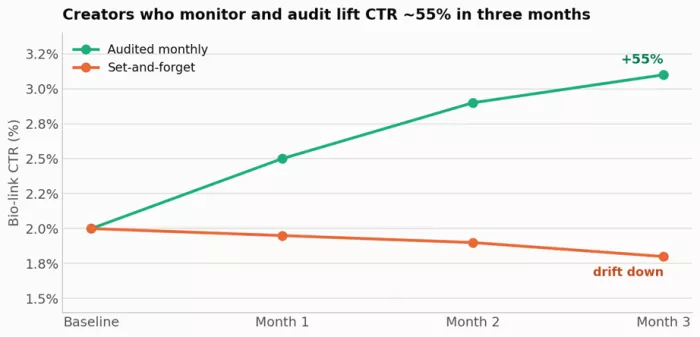
Figure 4 — Two identical starting points, three months apart. The audited page climbs; the set-and-forget page drifts down as links go stale.
Where clicks actually leak
Your bio link sits inside a funnel, and every stage loses people. Seeing the shape of that funnel tells you which leak is worth fixing first. For a creator turning 10,000 monthly reach into a handful of sales, the biggest percentage drops and the biggest opportunities are usually the profile-visit-to-click and click-to-conversion steps the audit protects.
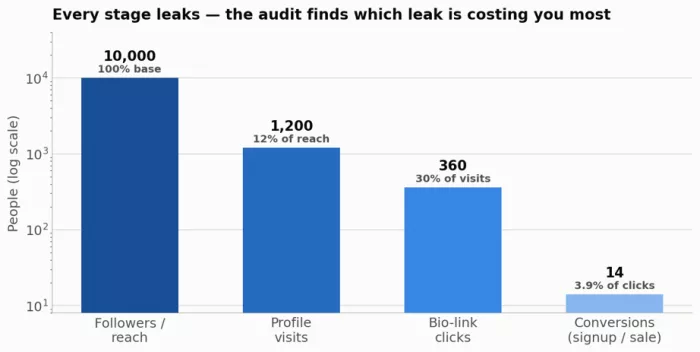
Figure 5 — An illustrative bio-link funnel. Small improvements at the click and conversion stages move revenue far more than chasing raw reach.
Reading Your Numbers: Benchmarks That Matter
Benchmarks are guardrails, not verdicts. A smaller, highly engaged audience often converts better than a huge passive one, and high-intent niches (finance, health, services) beat entertainment on CTR because the audience arrives with a need. Grade yourself against your own lane and, above all, against your own last month.
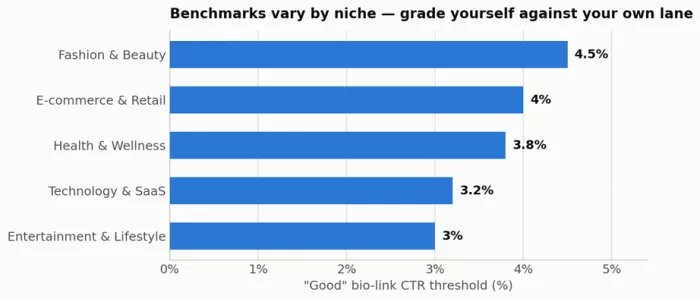
Figure 6 — Illustrative “good” bio-link CTR thresholds by niche. Use them as a rough floor, not a universal target. Source: InfluenceFlow industry benchmarks (2026).
| Metric | What it tells you | Rough healthy range |
|---|---|---|
| Bio-link CTR | Whether your bio is compelling enough to earn the tap | 1–3% cold; 8–15% from profile visits |
| Conversion rate | Whether the page delivers on the promise after the click | 1.4–3.4% unoptimised; 5–8% warm & optimised |
| Page load time | Whether speed is silently costing you clicks | Under ~2 seconds on mobile |
| Links on page | Whether focus or clutter is winning | 4–8 focused options |
Turning the Audit into Growth
The audit protects your baseline. Optimisation raises it. Once your monthly pass is clean, the same data points you at the highest-leverage experiments. Optimising a funnel — branded links, a focused page, one clear CTA — roughly doubles to triples conversion at every audience temperature.
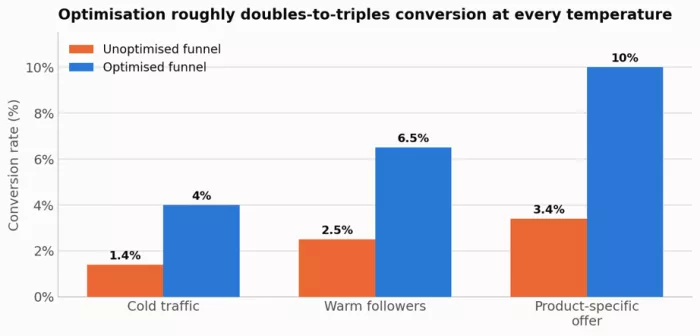
Figure 7 — Optimised vs. unoptimised conversion by audience temperature. Warm, focused funnels compound the most. Source: SimpleURL, creator funnel benchmarks (2026).
High-leverage experiments to try next
Test one CTA at a time. Change a single button’s wording and watch CTR for a week. ‘Get the free guide now’ vs ‘Download the guide’ is a classic, zero-cost test.
Move to a focused landing page. Custom pages with one clear CTA can convert 25–40% better than a generic multi-link directory. Use a link list only when you genuinely have 5+ equally important resources.
Add email capture. Creators using email capture and A/B testing report roughly 2.3× higher conversion than those using a plain link list.
Match the link to your content calendar. High-performing creators update the hero destination 1–2× a week to match what they’re posting using an editable branded link so the public URL never changes.
Consider warmer paths for key offers. Story link stickers and DM-delivered links convert far higher than a cold bio tap (Figure 1). For launches, route people through those instead of relying on the bio alone.
Common Mistakes to Avoid
| The mistake | The fix |
|---|---|
| Too many links | Cut to 4–8. Choose one hero action; demote the rest. |
| Set-and-forget mentality | Run this 30-second audit monthly; refresh the hero weekly. |
| Broken / outdated links | Tap every link each month; kill stale campaigns immediately. |
| Ignoring mobile & speed | Audit on a phone; keep load under ~2 seconds. |
| No call to action / no tracking | One clear CTA; confirm analytics and UTMs are firing. |
| Swapping the URL constantly | Keep a stable master link; edit its destination behind it. |
Make It a Habit: Your Monthly Routine
The audit only works if it actually happens. Anchor it to something you already do so it never slips.
- Set a recurring reminder on the first of the month or tie it to your content-calendar review, so the audit rides along with planning you already do.
- Run the 8-point checklist on your phone. Thirty seconds, in order, no rebuilding.
- Fix the single weakest thing you found not everything, just the one with the most impact this month.
- Log your key number next to last month’s so you always have a trend.
- Once a quarter, go deeper: pick one optimisation experiment from section 7 and give it a proper test.
The 30-day rule of thumb Audit monthly, refresh your hero link weekly, and run one deeper optimisation each quarter. That cadence keeps a bio link healthy without ever becoming a chore. |
Key Takeaways
- Your bio link is a funnel, not a formality — treat it like your most valuable pixel.
- A monthly 30-second audit catches the dead links, slow pages and clutter that silently kill conversions.
- Run the 8-point checklist on a real phone, fix the weakest point, and log your CTR.
- Monitoring and small fixes can lift CTR ~55% in three months; neglect drifts it down.
- Grade against your own niche and your own last month, then optimise the biggest leak.



Comments